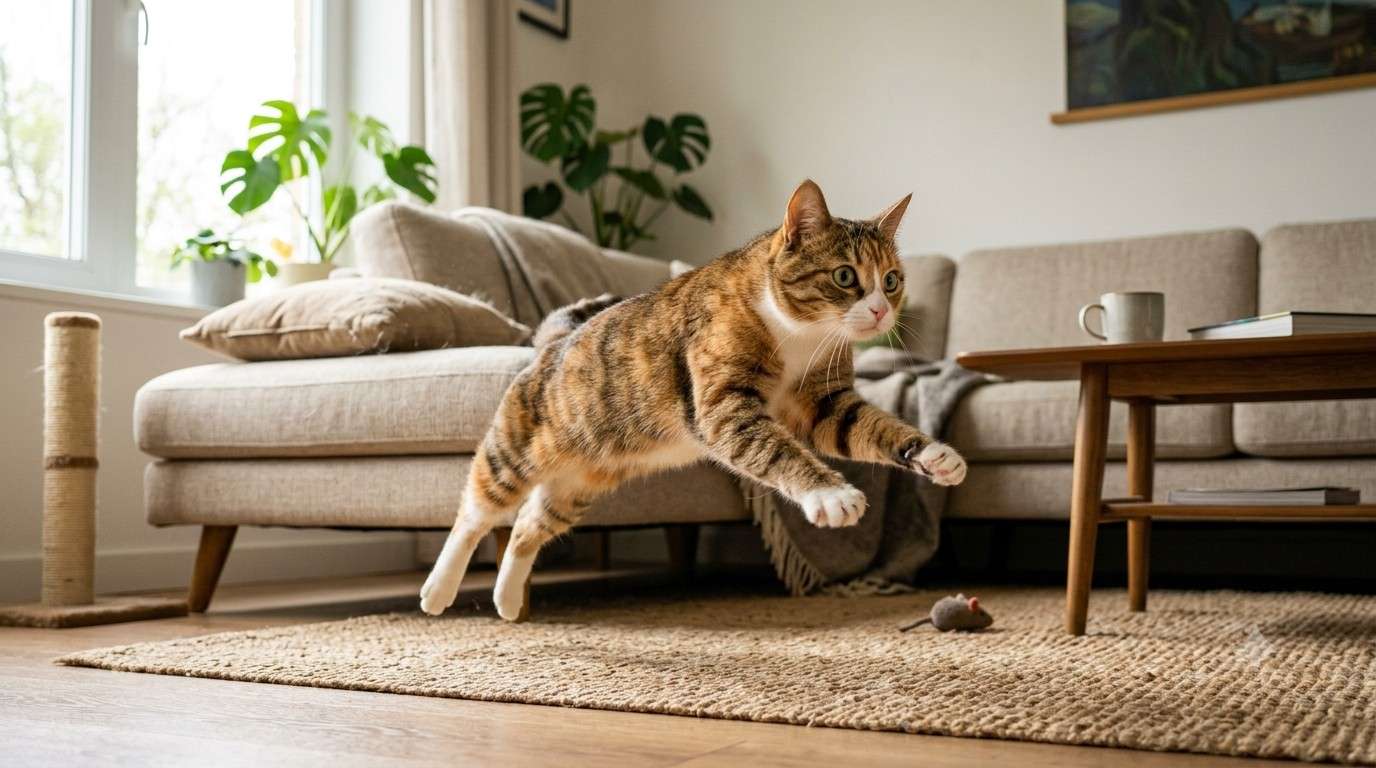
Cats have a remarkable talent for confusing us.
One moment, your cat is peacefully curled up beside you, purring like a tiny motor. The next, it is racing through the house at full speed for no obvious reason. It may stare intensely at an empty wall, knock something off a table, disappear for hours, and then suddenly demand your attention.
To humans, cat behavior can seem strange, unpredictable, and sometimes downright hilarious.
But behind those mysterious habits is a fascinating combination of instinct, communication, curiosity, and personality.
From purrs and kneading to midnight zoomies and slow blinks, understanding cats means learning to see the world from their perspective.
Why Do Cats Purr?
The purr is probably one of the most recognizable sounds associated with cats.
Most people associate purring with happiness, and cats certainly do purr when they are relaxed and comfortable. You might hear it while your cat is being stroked, settling into a favorite sleeping spot, or spending time with someone it trusts.
But purring isn't always a simple expression of happiness.
Cats may also purr when they are stressed, frightened, uncomfortable, or seeking reassurance. In some situations, purring may function as a self-soothing behavior.
This is why context matters.
If your cat is purring while relaxed with its body loose and eyes half-closed, it is probably enjoying the moment. If it is purring while hiding, behaving unusually, or showing signs of distress, it may be communicating something else.
The humble purr is more complicated than it sounds.
The Mystery of the Zoomies
Few cat behaviors are as entertaining as the sudden burst of energy commonly known as the zoomies.
Your cat may suddenly sprint from one room to another, jump onto furniture, spin around, and race back again.
Why?
Often, these bursts of activity are simply a way for cats to release built-up energy. Indoor cats, especially, may have fewer opportunities to run, chase, climb, and hunt than their wild relatives.
Zoomies can also happen after using the litter box, during playtime, or at times when a cat naturally becomes more active.
Cats are generally most active around dawn and dusk, reflecting their evolutionary history as hunters that often operate during low-light periods.
So if your cat decides that 2 a.m. is the perfect time for a household marathon, it may not be trying to disturb you. Its internal clock simply has different ideas about bedtime.
Why Do Cats Knead?
Have you ever watched a cat repeatedly push its paws against a blanket, pillow, or even your lap?
This behavior is called kneading, and it begins very early in a cat's life.
Kittens knead their mother's belly while nursing, helping stimulate milk flow. Many cats continue the behavior into adulthood.
For adult cats, kneading may be associated with comfort, relaxation, affection, or a feeling of security.
Some cats knead soft blankets. Others knead their owner's lap. And some become particularly enthusiastic about it, extending their claws just enough to make the experience less comfortable for the human involved.
If your cat kneads you, however, it is generally a good sign.
It may be saying, in its own peculiar way, that it feels safe.
The Slow Blink: A Cat's Version of a Smile
Cats don't express affection exactly like humans do.
Instead of smiling or hugging, they may communicate trust through subtle body language.
One of the most recognizable examples is the slow blink.
When a cat looks at you and slowly closes and opens its eyes, it may be communicating that it feels comfortable and relaxed around you.
You can even try returning the gesture.
Look toward your cat without staring intensely, slowly close your eyes, and then open them again.
If your cat responds, congratulations—you may have just participated in a tiny conversation without saying a word.
Sometimes, a cat's smallest gestures can say more than its loudest meow.
— Understanding feline body language
Why Do Cats Knock Things Over?
Cats have a special relationship with objects placed near the edge of tables.
A glass? Fascinating.
A pen? Fascinating.
An expensive decorative item? Apparently irresistible.
While it can look like cats knock objects down purely to annoy their owners, there are more practical explanations.
Cats are naturally curious and use their paws to investigate objects. Moving something can reveal how it behaves, whether it makes a sound, and whether it might be interesting to chase.
There is also the simple reality that cats enjoy interaction.
If knocking a pen off a desk consistently causes a human to react, the cat may learn that this behavior gets attention.
From the cat's perspective, the experiment was successful.
Why Do Cats Stare at Empty Walls?
Few things are more unsettling than watching your cat suddenly stare intensely at a completely empty section of the room.
But cats experience the world differently from us.
Their senses are highly developed, particularly their hearing and vision. They may notice tiny movements, faint sounds, insects, shadows, or other details that humans simply cannot detect.
A cat staring at a wall may be responding to something as ordinary as a tiny insect or a sound coming from inside the wall.
So before assuming your cat has discovered a supernatural presence, consider that its senses may simply be picking up something you missed.
Why Do Cats Bring You "Gifts"?
Some cats bring their owners toys. Others bring objects they find around the house. Outdoor cats may occasionally bring something considerably less welcome.
This behavior is often connected to hunting instincts.
Cats are predators by nature, and even domesticated cats retain strong hunting behaviors. Chasing, catching, carrying, and presenting objects can all be part of that instinctive sequence.
When a cat brings something to you, its motivation can vary. It may be playing, practicing hunting behavior, seeking attention, or interacting socially.
The important thing to remember is that your cat probably doesn't understand why you don't appreciate its latest "present."
Why Do Cats Love Boxes?
Give a cat an expensive bed and it may ignore it.
Give the same cat a cardboard box and suddenly you've created the most luxurious residence imaginable.
This behavior has a practical explanation.
Boxes provide cats with enclosed spaces where they can hide, observe their surroundings, and feel secure. As animals that can be both predators and prey in different circumstances, cats often benefit from having places where they can retreat and monitor their environment.
Boxes can also provide warmth.
Cardboard is a surprisingly effective insulator, and a small enclosed space can help a cat conserve body heat.
So when your cat chooses a delivery box over its expensive new bed, it may actually be making a perfectly sensible decision.
What Is Your Cat Trying to Say?
Cats communicate constantly, but they don't rely on vocalizations alone.
Their ears, tails, eyes, whiskers, posture, and movements all provide clues.
A relaxed cat may have a loose body, neutral ears, and a gently positioned tail.
A frightened or stressed cat may crouch, flatten its ears, puff up its fur, or try to make itself appear larger.
A rapidly flicking or thumping tail can indicate irritation or heightened arousal, especially when combined with other tense body language.
Learning to read these signals can dramatically improve the relationship between cats and their humans.
Instead of asking, "Why is my cat acting weird?" you can start asking, "What is my cat communicating?"
Why Cats Suddenly Want Attention
Cats have a reputation for being independent, but that doesn't mean they don't crave social interaction.
Some cats follow their owners from room to room. Others sit beside them while they work. Some demand attention at the least convenient possible moment.
A cat may rub against your legs, sit on your keyboard, nudge your hand, or meow repeatedly when it wants interaction.
Different cats have different social personalities.
Some are affectionate and outgoing. Others prefer being nearby without being touched. Respecting those individual boundaries is an important part of building trust.
With cats, affection often works best when it is offered rather than forced.
Why Cats Sleep So Much
Cats are famous for sleeping.
Adult cats commonly spend a large portion of their day sleeping or resting, although individual needs vary.
This behavior is connected to their evolutionary history. Hunting requires bursts of intense physical effort, so conserving energy between periods of activity makes biological sense.
Even domesticated cats retain this pattern.
Your cat may appear lazy while sleeping for hours on the sofa, but that doesn't necessarily mean it is doing nothing. Rest is an important part of maintaining energy for those sudden moments when it decides to sprint around the house at maximum speed.
Every Cat Has Its Own Personality
Perhaps the most important thing to understand about cats is that there is no single "cat personality."
Some cats are confident and adventurous. Others are shy and cautious. Some want constant companionship, while others are happiest observing the household from a quiet corner.
Breed, genetics, early experiences, environment, age, and individual temperament can all influence behavior.
This means that understanding your own cat requires observation.
Pay attention to what makes it comfortable, what causes stress, when it becomes playful, how it communicates, and which forms of interaction it enjoys.
Over time, you begin to develop your own language together.
When Strange Behavior May Mean Something Is Wrong
Although many unusual cat behaviors are perfectly normal, sudden changes should not automatically be dismissed as personality quirks.
If a cat suddenly stops eating, hides much more than usual, becomes unusually aggressive, changes its litter-box habits, vocalizes excessively, or shows other unexplained behavioral changes, it may be worth consulting a veterinarian.
Cats are particularly good at hiding signs of illness, so noticeable changes in behavior can sometimes be important clues.
Knowing what is normal for your individual cat makes it easier to recognize when something is different.
The Strange World of Cats
Cats may never become completely predictable—and perhaps that's part of their charm.
Their purrs, kneading, zoomies, slow blinks, mysterious stares, sudden attacks on invisible objects, and obsession with cardboard boxes make them endlessly fascinating companions.
But beneath the weirdness is a remarkably sophisticated animal shaped by instinct, sensory abilities, communication, and individual personality.
Once you learn to understand those signals, your cat's behavior starts to look a little less mysterious.
The midnight zoomies become a burst of energy.
The slow blink becomes a sign of trust.
The kneading becomes a comforting ritual.
And the cardboard box?
Well, some mysteries are probably better left unexplained.
Conclusion
Understanding cat behavior isn't about making every feline action predictable. It's about recognizing the instincts, emotions, communication signals, and individual personality behind those seemingly strange habits.
From the comforting rhythm of a purr to the sudden chaos of midnight zoomies, cats are constantly communicating with the world around them.
The more closely we observe them, the easier it becomes to understand what they are trying to tell us.
Perhaps the strange world of cats isn't so strange after all. We simply have to learn how to see it from their perspective.